314,209 sq ft of greenhouse across four ranges, subdivided into individually zoned bays, plus 20,148 sq ft of offices and labs — purpose-built space for agtech companies, seed breeders, and research teams to run real trials at real scale.
Most research programs are bottlenecked by space — waiting on a university greenhouse, squeezing trials into a production house, or building from scratch. This campus already exists, and it's built to be divided, controlled, and shared.
Four ranges already partitioned into individually numbered greenhouse bays — take a single bay for a pilot or a full range for a multi-season program.
Independent climate zones plus an automated blackout curtain range for photoperiod work — the repeatability trials require, in a mild coastal climate that lowers energy load.
Minutes from the Salinas Valley's growers and the USDA's crop research center, and within an easy drive of Silicon Valley's robotics and computer-vision talent.
The campus supports a wide range of controlled-environment research programs — from early-stage screening through pre-commercial validation.
Run imaging rigs and vision models against consistent, repeatable canopies with controlled lighting and backgrounds.
Impose heat, drought, and stress regimes by zone to select for resilience without waiting on the weather.
Evaluate biostimulants, biocontrols, and soil microbial products in isolated bays with clean controls and replication.
Segregated bays support inoculation studies and resistance screening with containment between trials.
Dial in light, temperature, humidity, irrigation, and nutrition curves — then validate the recipe at production scale.
Wide bays, level floors, and repeatable row layouts make a practical proving ground for autonomous platforms.
Benchmark soil, canopy, and climate sensors — and irrigation hardware — against controlled, instrumented baselines.
Side-by-side variety trials under identical conditions, replicated across bays for clean, defensible comparisons.
Develop medicinal and specialty crops where compound expression and trait consistency depend on tight environmental control.
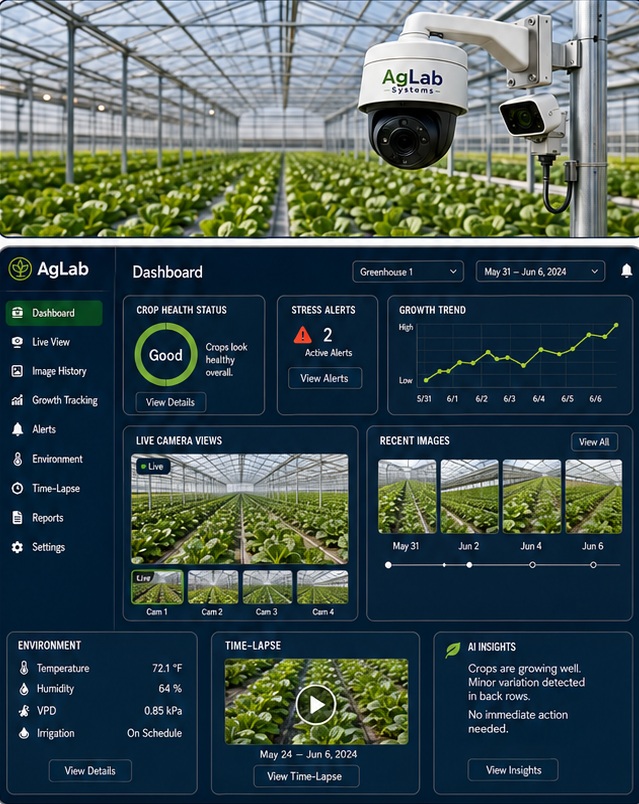
The campus is built to be instrumented. Cameras, sensors, and machine-learning models turn each greenhouse bay into a stream of objective data — so growth, stress, and yield are measured continuously, not guessed. Tenants can plug into it, or run their own.
RGB, depth, multispectral, and thermal cameras — fixed overhead, on rail gantries, or on scouting robots — image every plant on a consistent schedule.
Models catch mildew, botrytis, mites, and nutrient stress from subtle color, texture, and thermal cues — often days before the eye can, pinned to the exact bay.
Automatic measurement of height, canopy, color, and growth rate for every plant, every day — with rolling harvest and yield forecasts.
A learning model of each bay anticipates temperature and humidity swings and adjusts proactively — steadier conditions, lower energy load.
Pre-wired power, network, mounting rails, and edge compute let a tenant deploy a vision or sensor trial on day one — no infrastructure build required.
Tenants own the data their trials generate. Sharing for benchmarking or model training is opt-in and by written agreement — never assumed.
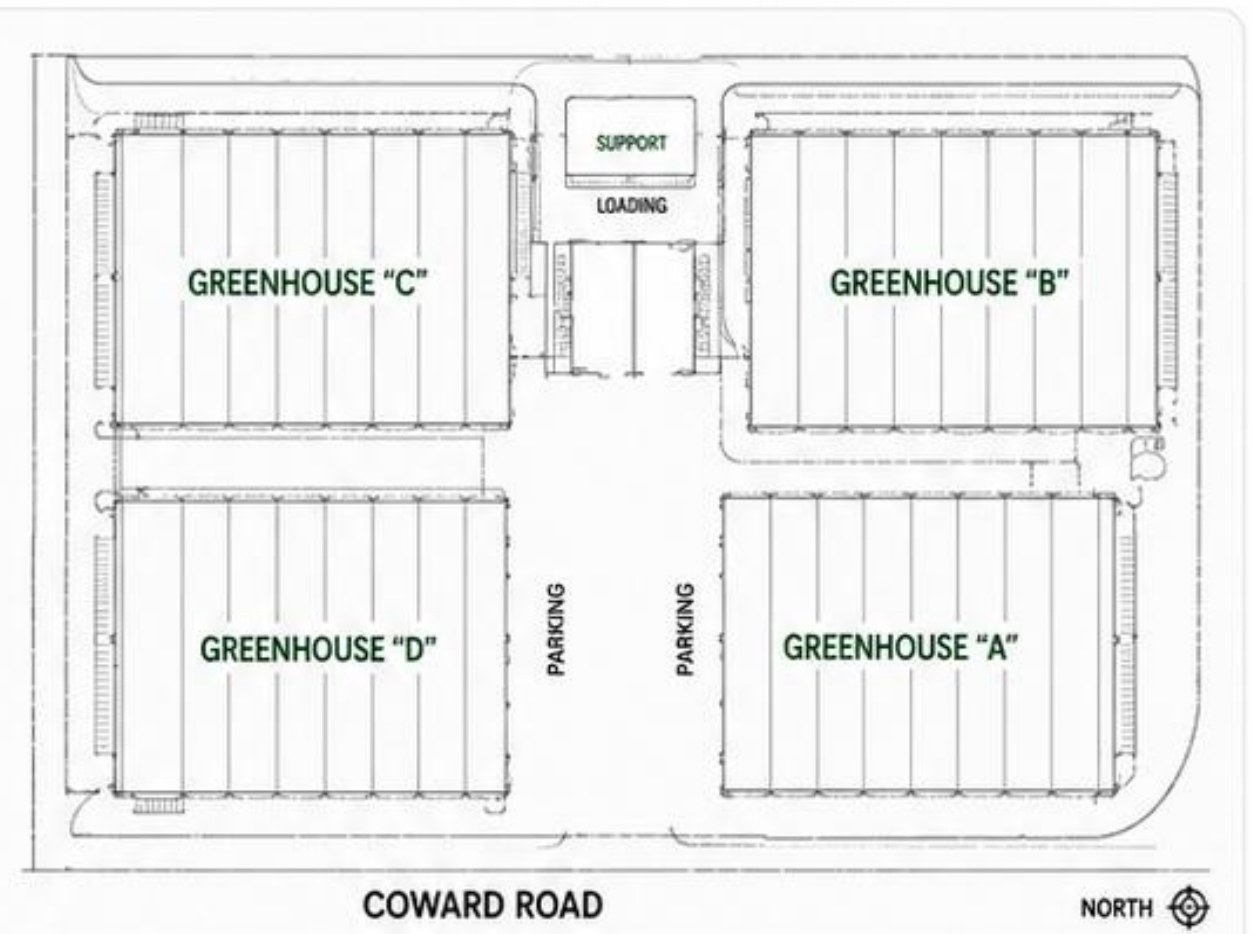
Every range is independently accessible and internally subdivided, so tenants can scale from a single trial bay to a dedicated range without moving sites. Shared offices, labs, parking, and service infrastructure sit at the center of the campus.
| Structure | Area | Notes |
|---|---|---|
| Greenhouse A | 86,332 sq ft | Individually numbered bays |
| Greenhouse B | 91,443 sq ft | Adjoins offices & labs |
| Greenhouse C | 71,360 sq ft | Automated blackout curtain |
| Greenhouse D | 65,077 sq ft | Individually numbered bays |
| Offices & Labs | 20,148 sq ft | Reception, offices, break, restrooms |
| Total campus | 10.3 acres | 334,357 sq ft under roof |
Full site plan showing all four greenhouse ranges, the central offices and labs, service areas, and parking. Tenancy can be configured around any combination of bays.
Watsonville sits at the top of the Salinas Valley — one of the most productive vegetable and berry regions in the world — and within commuting distance of the engineering talent building the next generation of agricultural technology.
The USDA-ARS Crop Improvement and Protection Research Unit — and its new Sam Farr U.S. Crop Improvement and Protection Research Center, a 117,000+ sq ft facility opened in 2023 — is a short drive south in Salinas.
Roughly an hour from San Jose and the wider Bay Area, putting robotics, computer-vision, and sensor teams within an easy day trip of their field trials.
Surrounded by the berry and vegetable operations of the Pajaro and Salinas valleys — commercial growers, cooling, and ag services are all local.
Close to UC Santa Cruz, Cal State Monterey Bay, and Hartnell College's ag technology programs for research partnerships and staffing.
| Destination | Approx. distance |
|---|---|
| Salinas (USDA-ARS) | ~20 miles |
| Monterey | ~30 miles |
| San Jose / Silicon Valley | ~35 miles |
| Santa Cruz | ~18 miles |
| Site | 10.3 acres |
Distances are approximate driving distances from 255/265 Coward Rd., Watsonville, CA.
Whether you need a single bay for one season or a full range for a multi-year program, we'll work with you to configure the space, infrastructure, and access your research requires.
Start a conversationShare a few details about your research and we'll come back with available bays, configuration options, and next steps.
We review every inquiry personally — no automated sales sequence.